
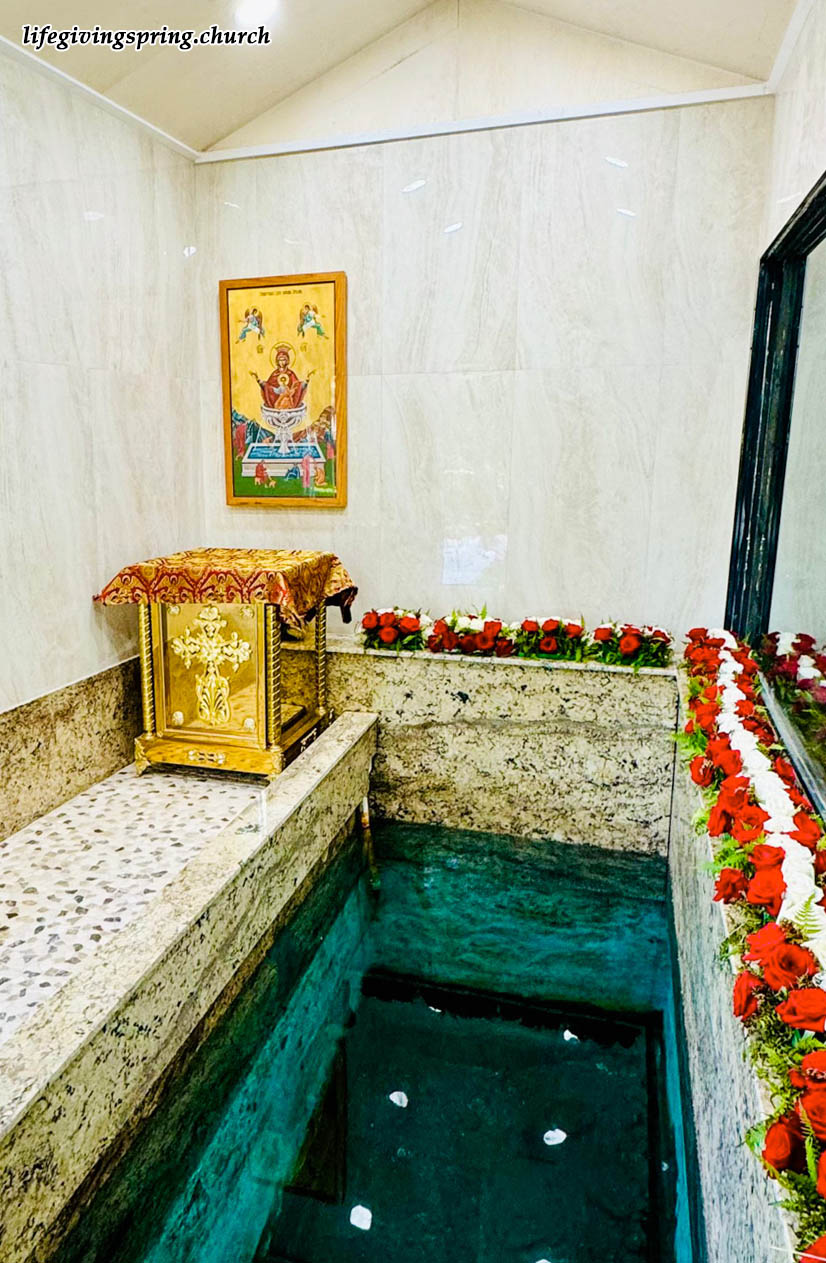
The Church of the Life-Giving Spring in Hot Springs is truly unique — right inside the church building there is a functioning natural spring. This is the first time something like this has happened in the history of Orthodoxy in America.
It’s the famous Big Chalybeate Spring — one of Hot Springs’ historic springs, long known for its healing waters. The first mentions of it date back to the early 19th century, and by the middle of that century, a bustling resort scene had already developed here that rivaled the very center of the city.
The building that now houses the church was originally constructed around this spring. During the reconstruction, the spring was carefully raised and beautifully incorporated into the design: a rectangular pool-font was created to collect the water. Now, as soon as anyone enters the church, they immediately see the living water — a powerful symbol that perfectly echoes the name of the church.
That’s why the decision to name the church after the icon of the Theotokos “Life-Giving Spring” was no accident — the name fits this place perfectly and naturally. The city of Hot Springs has been famous for thousands of years for its healing springs. It’s no surprise that the term “life-giving” (живоносный, животворящий) applied to the local springs appeared in American publications long before the Orthodox church with that name was established here. You can find it especially often in 19th-century printed materials.
– “Meantime the earth will revolve on its axis, and for the benefit and healing of all else requiring medical aid the Arkansas hot springs will continue to pour forth their ex-haustless volumes of pure, life-giving waters from the thermal fountains of nature” (De Bow’s Review and Industrial Resources, Statistics, Etc, 1867).
– “The life-giving qualities of these waters have been famous for years. They are particularly efficacious in the treatment of gout, chronic rheumatism, contraction of the joints, syphilis, neuralgia, paralysis, diseases of the skin, functional diseases of the uterus, and chronic poisoning by metals, but they are positively injurious in affections of the heart or brain or dropsies of the lungs” (A History of the North-western Editorial Excursion to Arkansas, 1876).
– “The morning following the banquet the train was run down the road 43 miles to Malvern, and a change of base was made to a train of flat cars, fitted up with rough board seats <…> Then came a solid dinner, an inspection of the wonderful life-giving and healthy water…” ( A History of the North-western Editorial Excursion to Arkansas, 1876)
– “In a narrow glen between two bold spurs of the Ozark Mountains, in Garland County, Arkansas, are found the most wonderful thermal springs, in their healing properties, now known in the world. The early voyagers who landed on our Southern coast were told by the natives of these wonderful life-giving springs” (The Hot Springs of Arkansas, 1877).
– “Much has been said and written concerning the Hot Springs of Arkansas; indeed, the evidence and personal experience of the thousands who have been benefited and cured by the healthful and life-giving influences which nature imparts through the agency of the waters which flow there in inexhaustible supply, area sufficient and satisfactory endorsement of their claims as the greatest and most successful “Natural Healer and Restorer” in This country if not in the world” (The Medical and Surgical Directory of the State of Iowa. Hot Springs of Arkansas, and how to get there, 1878).
– “When all her resources come to be known her rich agricultural lands, her mineral deposits, her matchless climate, her life-giving springs, her inexhaustible forests, her unequaled water power, her numerous navigable streams, the great variety of vegetable production – emigrants will seek to avail themselves of such advantages, as speculators are already doing” (The Encyclopedia of the New West, 1881).
– “These grounds are situated in one mile and one quarter from the Hot Springs, from which issue the life-giving streams which bear healing to thousands annually” (Arkansas. General Assembly. House of Representatives, 1881).
– “Arkansas is the land of springs, furnishing pure, cold, life-giving waters, and here are also to be found many springs whose waters hold in solution various kinds of minerals which impart to them properties adapted for healing certain classes of diseases incidental to the human race” (Arkansas, Statistics and Information, 1888).
– “After ten years in Huntsville, Fordyce was forced by his failing health (due to old war wounds) to go to Hot Springs, Arkansas for a last chance at recovery. After only months of treatment at the then-primitive spa area, he returned, renewed, to Huntsville, grateful for the life-giving springs. He moved his family and interest in business enterprises to Hot Springs in 1876” (Pioneers of American Landscape Design II, 1995).
The Church of the Life-Giving Spring in Hot Springs is a unique and harmonious blend of Orthodox tradition and a local natural and historical landmark. The active healing spring inside the temple is not only the first of its kind in the history of American Orthodoxy, but it has also organically embodied the ancient symbolic name of the icon of the Theotokos — a name that has been naturally associated with the hot springs of Arkansas for more than a century and a half.